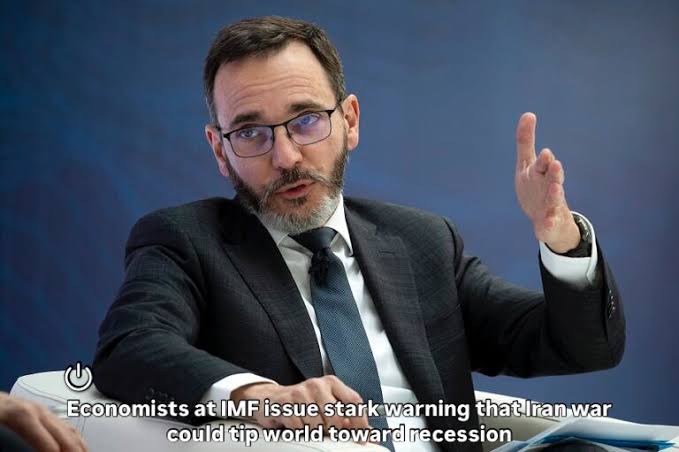
The International Monetary Fund has lowered its global growth outlook for 2026, signaling rising concern over the resilience of the world economy amid geopolitical uncertainty, persistent inflation risks, and fragile financial conditions.
In its latest assessment, the IMF projects slower growth under its baseline scenario, reflecting mounting pressures facing both advanced and emerging economies. While the revised outlook stops short of predicting a downturn, the warning is clear: the global economy is entering a more vulnerable phase.
What has drawn particular attention is the IMF’s caution that a worsening geopolitical environment could push the world much closer to recession risk. That warning comes as markets contend with conflict-driven energy volatility, trade disruptions, sovereign debt concerns, and weakening investor confidence.
For policymakers and investors, the downgraded outlook reinforces growing concern that the post-crisis recovery remains uneven and exposed to shocks. Higher interest rates, softer demand, and rising fiscal pressures are already weighing on growth, while geopolitical instability threatens to amplify those risks.
The warning also carries implications far beyond financial markets. Slower global growth can affect trade flows, commodity demand, employment, capital investment, and development financing, particularly in vulnerable economies that remain exposed to external shocks.
For businesses, the IMF’s revised outlook may prompt greater caution around expansion plans, capital allocation, and risk management. For governments, it raises pressure to balance inflation control with growth support in an increasingly uncertain environment.
The broader message from the IMF is that the global economy is not in crisis, but it is operating under growing strain. And in a world where geopolitical tensions can rapidly spill into energy markets, trade systems, and financial conditions, the margin for policy error is becoming narrower.
As recession risks move back into the conversation, the IMF’s warning serves as a reminder that the biggest threat to growth may not be a single event, but the accumulation of interconnected pressures building across the global system.
Leave a Reply