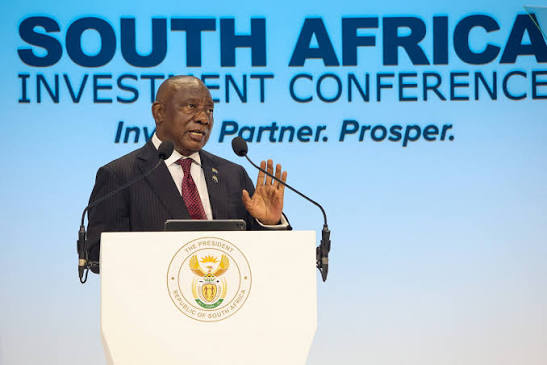
South Africa is once again commanding the attention of global capital—an economy that, despite its complexities, continues to inspire significant financial commitment from investors who understand the long game. In 2026 alone, the country has secured nearly R900 billion in investment pledges, a figure that speaks not only to its enduring strategic value, but to the quiet confidence it still commands within international boardrooms.
Yet beneath this impressive headline lies a more nuanced reality—one that separates ambition from execution.
Only about 42% of these pledged investments are ultimately implemented, a figure that falls well below global benchmarks and introduces a critical tension into South Africa’s economic narrative. It is not a lack of interest that defines the market, but rather the friction between intent and delivery. Investors are willing. Capital is available. The vision is compelling. But the pathway from promise to performance remains uneven.
This gap is not merely a statistic—it is a signal.
It reflects structural inefficiencies that continue to shape the country’s investment climate: regulatory delays, infrastructure inconsistencies, policy uncertainty, and administrative bottlenecks that slow momentum at precisely the moment it should accelerate. For sophisticated investors, this is not necessarily a deterrent—but it is a filter. South Africa is no longer a market for passive capital. It is a terrain that rewards precision, local intelligence, and strategic patience.
And yet, this is precisely where its allure deepens.
Because within that execution gap lies opportunity—the kind that does not reveal itself to the crowd, but to those who understand how to navigate complexity with quiet authority. Investors who succeed in South Africa are not simply deploying capital; they are embedding themselves within systems, building relationships, and aligning with long-term national priorities.
In many ways, South Africa is evolving into a high-conviction market. One where capital must be intentional, structured, and resilient. The rewards, while not immediate, are often deeply anchored—rooted in sectors such as energy transition, infrastructure modernization, financial services, and industrial development.
For the country itself, the challenge is clear. The next phase of its economic evolution will not be defined by how much investment it attracts, but by how effectively it converts that interest into tangible outcomes. Closing the gap between pledge and implementation is no longer a technical issue—it is a strategic imperative tied directly to credibility, competitiveness, and long-term growth.
Because in today’s global economy, capital does not simply follow opportunity. It follows execution.
South Africa, poised between promise and performance, now stands at a defining threshold. If it can align its ambition with delivery, it will not merely attract investment—it will command it, with a level of authority that transforms perception into power, and potential into legacy.
Leave a Reply