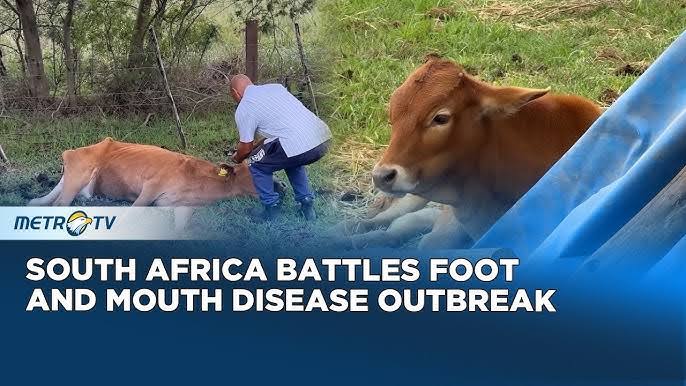
South Africa’s agricultural sector—long regarded as a quiet pillar of resilience within the economy—is facing a renewed test of stability as a major outbreak of Foot-and-mouth disease forces urgent government intervention. The decision to import vaccines and accelerate containment measures reflects not only the seriousness of the situation, but the high stakes attached to it.
This is not merely a veterinary concern. It is an economic one.
Livestock production sits at the heart of South Africa’s agricultural exports, feeding into regional and global markets that demand strict compliance with animal health standards. When an outbreak of this scale emerges, it triggers immediate scrutiny from trading partners. Export channels can slow, restrictions can tighten, and in some cases, access to key markets can be temporarily suspended.
The ripple effects are swift. Farmers face uncertainty, supply chains tighten, and the broader agribusiness ecosystem—from processors to logistics operators—feels the strain. What was once a stable export pipeline becomes a delicate balancing act between containment and continuity.
The government’s response signals awareness of this urgency. By moving quickly to secure vaccines and limit the spread, authorities are attempting to protect not just livestock, but the credibility of South Africa’s agricultural exports on the global stage. In today’s competitive trade environment, reputation is as valuable as production capacity. Once compromised, it can take years to rebuild.
Yet the outbreak also exposes a deeper vulnerability. Agriculture, often perceived as grounded and predictable, is increasingly shaped by biosecurity risks that can disrupt even the most established systems. In a world where disease outbreaks can alter trade flows overnight, resilience is no longer just about output—it is about preparedness, surveillance, and rapid response.
For investors and industry players, this moment reinforces a critical reality: South Africa’s agricultural strength remains intact, but it is not immune to disruption. The sector continues to offer long-term value, yet it demands a more sophisticated understanding of risk—one that includes not only climate and market dynamics, but also the evolving landscape of animal health and global trade regulation.
In the immediate term, the priority is containment. In the long term, the focus will shift to reinforcement—strengthening systems, restoring confidence, and ensuring that South Africa’s position as a trusted agricultural exporter is not only preserved, but elevated.
Because in global agriculture, access is everything. And in moments like this, it is not just livestock that must be protected—but the pathways to the world’s markets.
Leave a Reply