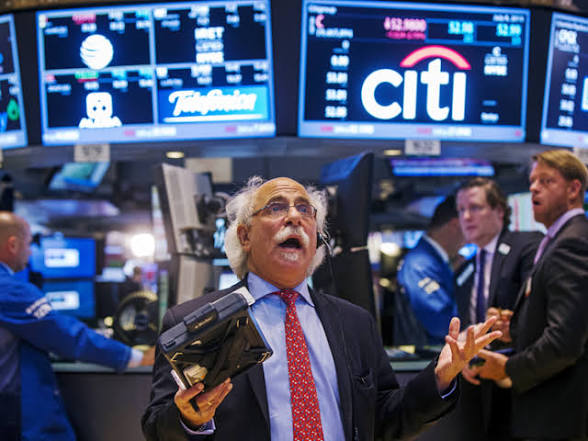
In the heart of Wall Street, where confidence has long been traded as actively as capital, a more complex narrative is beginning to take shape. On the surface, activity remains resilient. Markets continue to move, deals are being structured, and capital is still finding its way into strategic sectors. Yet beneath this momentum, a quieter tension is building—one defined not by immediate crisis, but by persistent uncertainty.
At the center of this dynamic is the evolving role of institutions such as the Federal Reserve, whose monetary policy decisions continue to ripple through every layer of the financial system. Interest rates, once predictable in their trajectory, have become a focal point of debate and caution. Investors are no longer simply responding to rate changes—they are attempting to anticipate a policy environment that feels increasingly reactive to global events rather than purely domestic conditions.
This uncertainty is not without reason. Global instability, from geopolitical tensions to disruptions in energy markets, is reshaping how investors assess risk. The traditional models that once guided long-term confidence are being tested by a world that no longer moves in steady cycles. Instead, volatility has become a defining feature, forcing even the most seasoned market participants to reconsider their strategies.
And yet, Wall Street does not slow easily. Capital markets continue to function with remarkable efficiency, and there is still a visible appetite for opportunity. Private equity firms remain active, institutional investors are reallocating portfolios, and sectors tied to technology and infrastructure continue to attract significant attention. It is this duality—strength in activity paired with caution in sentiment—that defines the current moment.
Investor confidence, once anchored in predictability, is now more fluid. Sentiment shifts quickly, often influenced as much by global headlines as by economic data. A single development in international relations or energy supply can alter market direction within hours. In this environment, confidence is no longer a fixed state—it is something that must be constantly reassessed.
There is also a growing awareness that liquidity, while still present, is more selective. Capital is moving, but it is moving with greater scrutiny. Investors are placing a premium on resilience, favoring sectors and strategies that can withstand external shocks. This has led to a subtle but significant shift in how risk is priced and how opportunities are evaluated.
What emerges is a portrait of a financial center in transition. Not weakened, but recalibrating. Not uncertain in its capability, but cautious in its outlook. Wall Street is continuing to operate at a high level, but with an undercurrent of awareness that the global environment has fundamentally changed.
In many ways, this moment reflects a broader evolution in financial power. The era of straightforward growth narratives is giving way to one defined by complexity, where success is measured not just by returns, but by the ability to navigate uncertainty with precision and foresight.
As the world around it continues to shift, Wall Street remains active—but it is no longer unquestioningly confident. Instead, it is watchful, adaptive, and acutely aware that in today’s interconnected economy, strength and uncertainty can exist side by side.
Leave a Reply